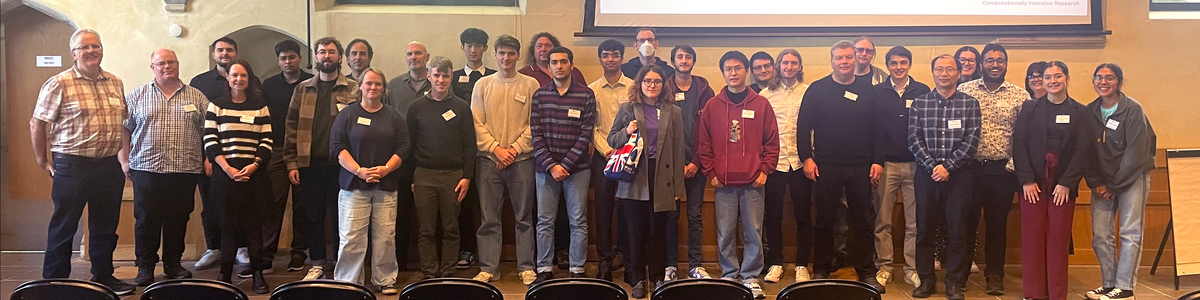
The N8 CIR hosted 24 internships across the N8 universities in the summer of 2024. These projects varied in design and covered all three key themes of digital health, digital humanities, and machine learning.
Here, you can find the list of the research projects. There is also a news article on the event in which students presented their work in September 2024 in York. Where available, their personal links take you to a video of their research presentation on our YouTube site.
DURHAM UNIVERSITY
|
Learning Semantically Meaningful Representations in Image and Music Data |
William Gould |
|
Reductio et Elaboratio ad astera!: Leveraging Bede's capabilities in Machine Learning for the Digital Humanities Task of Explainable Music Generation |
Matthew Blessing |
|
Diminishing Biases for Dermoscopic Images using Diffusion-based Data Augmentation |
Junjie Shentu |
|
Learning to run social network analyses on historical data at scale with HPC |
Caterina Keri |
LANCASTER UNIVERSITY
|
Extreme scale text analysis pipelines: comparative evaluation of UCREL-Hex, Lancaster-HEC and N8-Bede, and development of training materials and demonstrator Python scripts and notebooks |
Henry Oldroyd |
UNIVERSITY OF LIVERPOOL
|
Data collection and deep learning models for music emotion recognition |
Aradhya Tripathi |
|
Improved inverse reinforcement learning for attacker's intention inference |
Wanrong Yang |
This research resulted in a publication:
W. Yang, M. Wang and D. Wojtczak, "Abstract Attack Intention Inference Using Low-Rank Gated Arithmetic Interactive Attention," 2025 IEEE International Conference on Cyber Security and Resilience (CSR), Chania, Crete, Greece, 2025, pp. 166-173, doi: https://doi.org/10.1109/CSR64739.2025.11129983
|
Benchmarking large language models for reading biomedical literature |
Chi Xing |
|
Software Development for Automated Pediatric Brain Tumor Detection, Classification and Segmentation with 3D Tumor Imaging Tool |
Ramandeep Kang |
THE UNIVERSITY OF MANCHESTER
|
Geospatial, textual, and computer vision approaches to research in the humanities |
Aadityaa Mehrotra |
|
Humanities data science: Geospatial, network, and textual analysis |
James Chattock |
NEWCASTLE UNIVERSITY
|
Ballast Hill burial ground |
Dovydas Vilkevicius |
|
Enhancing Healthcare for Older Adults: Predictive Heart Monitoring Using Wearable Technology - Data Science Application |
Luca Albinescu |
UNIVERSITY OF SHEFFIELD
|
Lingustic Bede |
Jonathan Clayton |
|
AI Care federated |
Jacob Cummins |
|
Unlocking the complexity of organismal colour patterns using artificial intelligence |
Ethan Hadfield |
UNIVERSITY OF YORK
|
Reducing Ethnical Bias in 3D Face Analysis Using a Neural Network Learned Natural Illumination Prior |
Harsh Mohan |
|
Deciphering the IHF-DNA Binding Mechanism: Implications for Suppressing Stubborn Bacteria |
Rehana Patel |
|
Knowledge Extraction using Large Language Models (LLMs) for Explainable Mental Health Assessment |
Yusif Ibrahimov |
|
Simulations on the H-NS protein: the sentinel of antibiotic resistance genes in bacteria |
Jimena Benedetto |
|
Pair Spectrometer Calorimeter Reconstruction Using Machine Learning |
Valentin Defayet |
|
CIZ1 Training Ground: U-Net Approach for Drag-and-drop Image Analysis |
Navin Shirodkar |