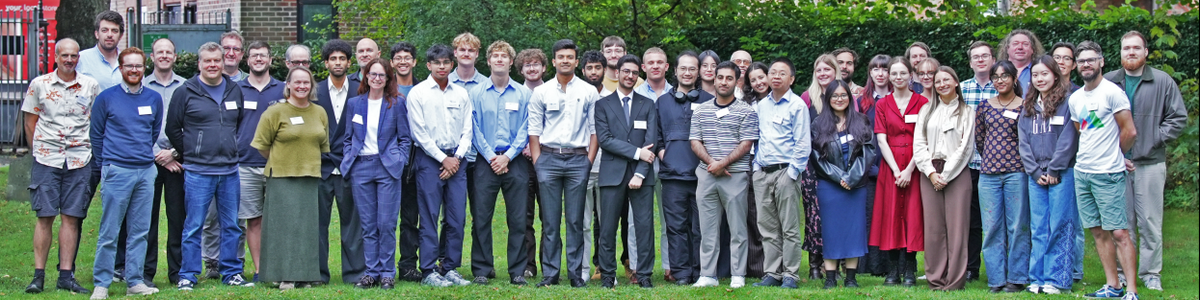
Projects are varied in focus, and we greatly enjoyed learning about the research in our Showcase on the 16th September.
The university links below show the projects, a student bio and their expectations before starting their internship. To learn about the conclusions of their research, see their slides, and watch their presentations, follow their personal link.
|
Deep Generalised Models |
Nguyen Thien An |
|
Establishing Machine Learning Protocols for Directed Synthesis and Reaction Optimisation |
Francesca Farrand |
|
Molecular Design of New Polymers for Surface Modification of Fabrics: A Multi-Scale Computer Simulation Approach |
Kinga Kornas |
|
MCMC Convergence and Tessellation Budget Sensitivity in the AddiVortes Model |
Lewis Maltby |
|
Automated Pest Detection in Plants |
Ernest Uche-Eze |
|
Revisiting the Risk Elicitation Puzzle: A Machine Learning Approach |
Anand Chavali |
|
GEM: a Domain-Specific Modelling Language for Disease Outbreak Models |
Crystal Leong |
|
Toward better energy and marginal carbon intensity data for research and teaching |
Luke Needle |
|
Creating a Historical Sentiment Lexicon Using Johnson’s Dictionary and HPC |
Millie Cain |
|
Population-Scale Biomechanics: Modelling of a Spinal Unit using HPC |
Namira Chowdhury |
|
Interpreting Readability Evaluation with Explainable AI |
Owais Mahmood |
|
Where did the English novel come from? Experimenting with computational approaches to investigate language in seventeenth-century prose fiction |
Nell Wilkinson |
|
Reinforcement Learning and Symbolic Transformer for Stability Certificates of Nonlinear Power Systems |
Abhiram Bainkrodu Bhat |
|
Machine Learning–Enabled Techno-Economic Analysis of Flexible Nuclear Power for Enhanced Renewable Integration in the GB Power System |
Luke Bennett |
|
ChannelGate: A Gating Network to Route Ion-Channel Data towards Optimal Deep-Learning Models |
Chengxu Jiang |
|
AI-Guided Discovery of Large-Band-Gap Dielectric Materials for Next-Generation Power Grids |
Shivansh Raj |
|
How well can large language models perform literature reviews? |
Abdullah Al Kalbani |
|
Sustainable AI Data Compression Case Study: Profiling BOA on BEDE |
Hanzila Hussain |
|
The Language of Early Capitalism: A Computational Analysis |
William Roper |
|
Identification of sub-groups of chronic obstructive pulmonary diseasepatients using clustering analysis of small airway histopathology |
Urbi Roychowdhury |
|
Explainable health data analytics with tsetlin machines |
Jamie Jeays |
|
Data Pre-processing and Generation for Real-World Neural Architecture Search Applications |
James Kaye |
|
Calculating Long-Time Quantum Trajectories Using Arbitrary Precision Floating Point Numbers on COMET |
George Maniadakis |
|
Deployed End-to-End Machine Learning on an Autonomous Racing Car |
Shamik Srimany |
|
From Simulation to AI: Physics-Informed Neural Networks for Chemical Kinetics in Turbulent Hydrogen Swirling Flames |
Adam Wilson |
|
AI for Smart Farming: Detecting and Identifying Cattle from Drone Images |
Eyad Ahmed Abdelaziz Abdelnabi Mohamed |
|
Improving the FLAME GPU User Experience through Examples |
Lewie Fleming |
|
GPU-Accelerated Domain Adaptation for Personalised Speech Recognition of Electrolarynx Voices |
Echo Garratt |
|
MobGap-Plus: An HPC-Powered ML Pipeline for Digital Mobility: Bridging Python & R-Shiny |
Artem Vakhutinskiy |
|
Parallel Hybrid Solving of Challenging Decision Problems |
George Jopson |
|
First-principles prediction of surface and nanocrystal properties of BaCd2P2 for optoelectronic applications |
Noah Minto |
|
Automated Biomechanical Pipelines for Personalized Diaphragmatic Assessment |
Prithwish Mukherjee |
|
High-Performance Proteomics at Scale: An R Package and Interactive Web Portal for Standardised Analysis |
Anna Scott |